Choose timezone
Your profile timezone:
Abstract:
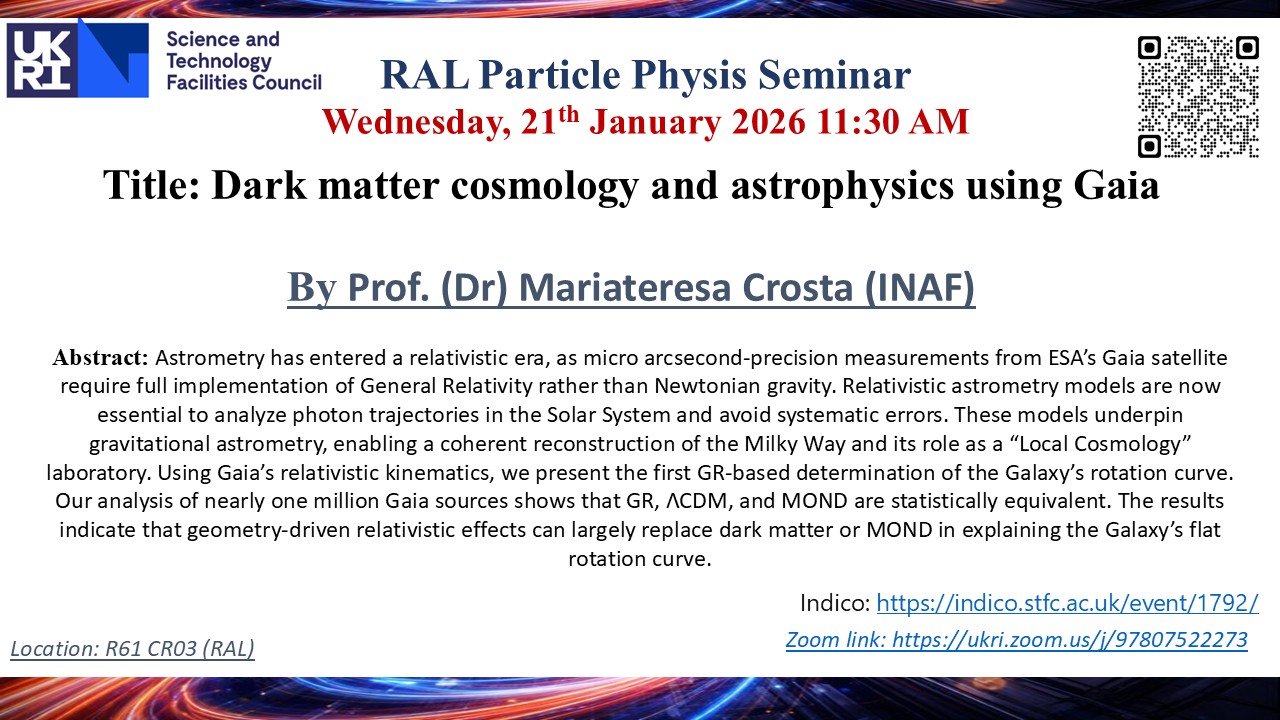
Astrometry, dedicated since immemorial time to measuring the positions and motions of stars in the Universe, is now dominated by Einstein's theory. High-precision space astrometry measurements, pioneered by ESA’s Gaia satellite, compel fundamental astronomy to abandon the classical paradigm based on Newtonian gravity in favor of Einstein’s General Relativity (GR), the current standard theory of gravity. Indeed, microarcsecond accuracy requires the rigorous use of the GR measurement protocol for analyzing photon trajectories within the ever-changing local gravitational fields of the Solar System. Consequently, Gaia's extremely precise and repeated measurements must implement relativistic astrometry models directly into the data analysis and processing to eliminate systematic errors and guarantee scientific results.
These advanced relativistic astrometry models form the basis of gravitational astrometry—the analysis of gravitational effects from the scale of the Solar System to that of the Galaxy—as they provide a coherent interpretation of General Relativity observables for reconstructing the Milky Way within theories of gravity. In addition, our entire Galaxy is the product of cosmological evolution shaped by gravity and serves as a "Local Cosmology" laboratory at zero redshift. Gaia data allow for the exploration of relationships between baryonic structures (and their evolution) and the dark components of the Universe, while providing the best model for other similar galaxies.
In this context, we present the first application of Gaia’s relativistic kinematics in tracing the rotation curves of the Milky Way. The observed flatness of these curves remains an outstanding problem in astronomy, typically requiring the invocation of a dark matter halo. Our most recent results compare an exact GR approach with (Λ)CDM and MOND models, utilizing nearly one million sources exclusively from Gaia, selected for an accurate and homogeneous reconstruction of the six-dimensional phase space (positions, proper motions, radial velocities, and distances). Likelihood analyses of velocity profiles, density, and dark halo/non-Newtonian components indicate that these models are statistically equivalent, validating the relativistic model for the Milky Way. These results suggest that gravitational dragging, derived from the solution of Einstein's equations, replaces (by 30-35% at the Sun and 100% from 10-15 kpc) the effects of dark matter or those predicted by MOND to explain the observed quasi-flatness of the galactic rotation curve, implying that no additional non-baryonic matter would be necessary. In brief, our ansatz suggests that geometry-driven effects could represent a new key for exploring the phenomena attributed to dark matter.
About Speaker:
Dr. Mariateresa Crosta is a Senior Researcher at the INAF - Astrophysical Observatory of Turin (OATo), holding the national scientific habilitation as a Full Professor in Astrophysics.
Her career is distinguished by pioneering work in gravitational metrology and the application of General Relativity to fundamental astronomy and local cosmology. Since 2000, she has been engaged in the ESA Gaia mission as a member of the Gaia Data Processing and Analysis Consortium (DPAC), where she manages the comparison and refinement of general relativistic models for data processing and analysis. She also serves as the Principal Investigator for the GAREQ experiment, which utilizes Gaia data to detect light deflection caused by Jupiter’s quadrupolar mass distribution and related weak gravitational effects. Her research has led to new contributions in the field of the General Relativistic reconstruction of the Milky Way. Furthermore, she lectures on "Gravitational Metrology for Astrophysics and Cosmology" at the University of Turin and is the founder and Chair of the interdisciplinary conference series "The Time Machine Factory”.