Choose timezone
Your profile timezone:
Over the past 80 years, progress in experimental nuclear and particle physics has relied on a succession of ever larger facilities, in particular particle accelerators and detectors. These engines of discovery are hosted in laboratories such as Fermilab, CERN, KEK and others.
Information technology has played an increasingly central role in these facilities. Systems for data acquisition, processing, analysis, simulation, and modeling are essential for producing physics results. Technologies such as the World Wide Web (WWW) emerged from this environment and helped usher in today’s highly connected society. In parallel, they gave rise to what may be called the global “Information Laboratory”: data-rich, software-driven, networked, open, and highly collaborative. Modern physicists, working from their screens, are now key research staff in this Information Laboratory.
Emerging AI technologies will bind the Information Laboratory even more closely to the physical laboratories, turning the world’s largest physics experiments into continuously learning discovery engines. An emerging community vision is that of “AI-native” experimental particle physics, embedding AI across detector design, intelligent sensing, autonomous operations, and analysis at exabyte scale. With the High-Luminosity Large Hadron Collider, Deep Underground Neutrino Experiment, and Electron-Ion Collider as near-term proving grounds, and future facilities such as the Future Circular Collider on the horizon, this talk offers a timely look at how AI can accelerate discovery and reshape the scientific lifecycle.
Peter Elmer is a Senior Research Physicist at Princeton University and a leading architect of modern software and computing for experimental high-energy physics. A long-time leader in CMS computing, he helped shape core systems that enabled precision measurements and major discoveries at the LHC. He is Executive Director and Principal Investigator of IRIS-HEP, widely recognized as the flagship U.S. software umbrella project for particle physics, driving shared R&D, production software, and workforce development across labs and universities. Elmer has been instrumental in helping coordinate international community roadmaps leading to creation of HEP Software Foundation (HSF), common software strategy, and cross-experiment collaboration that now underpin the AI-enabled future of the field.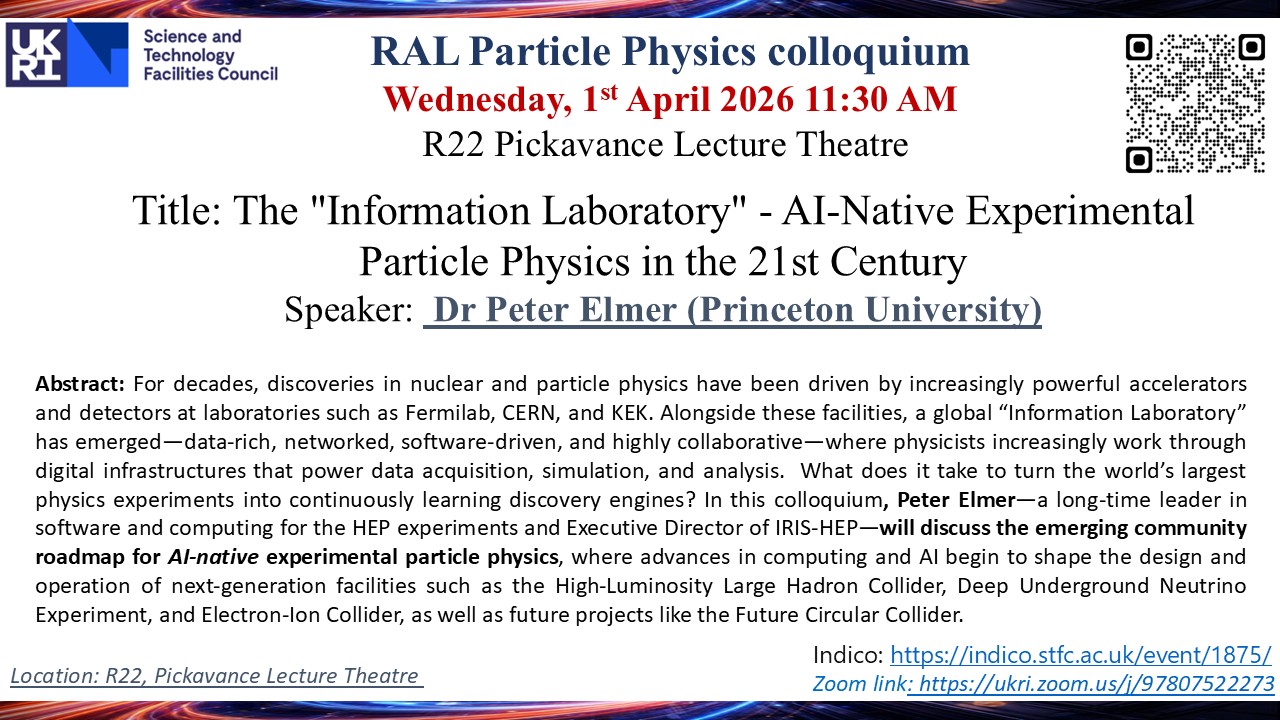
Dr Brij Kishor Jashal