Choose timezone
Your profile timezone:
Abstract:
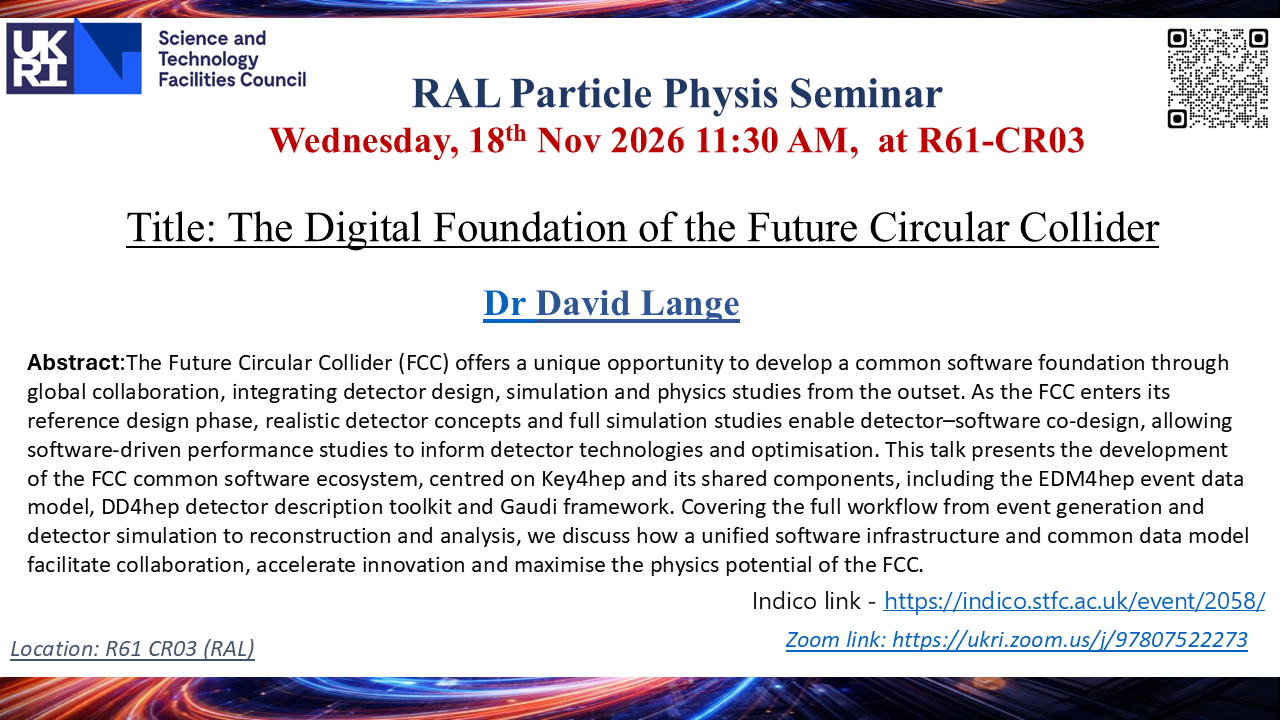
Large experimental facilities in particle physics are designed, built and run by multinational collaborations. Over many decades these communities have learned to combine regional strengths and interests into shared projects. Most of that experience has come from building hardware and instruments. Today, software is just as important: it is used to design the detectors, to judge the physics case, and eventually to get the most discovery potential out of the data.
The Future Circular Collider (FCC) is now in its reference design phase. Its conceptual detector designs are maturing, including realistic interaction region layouts, and its physics studies are increasingly based on full simulation. This makes it a rare chance to build the software collaboratively from the beginning. It also opens the door to detector–software co-design: if simulation and reconstruction are realistic enough this early, their results can directly shape the choice of detector technologies and parameters, rather than software being fitted to a detector that is already fixed.
This talk describes how the FCC community is meeting that challenge by building on common software. Its core is Key4hep, a software ecosystem developed together with other future-collider communities. It is built on shared components such as the EDM4hep event data model, DD4hep detector descriptions and the Gaudi framework, and supplies everything from event generation and full simulation through reconstruction to analysis pipelines. We show how a common software foundation and data model facilitates detector concept design and eases the adoption of new ideas into physics performance studies.
About Speaker:
Dr. David Lange is an experimental particle physicist whose area of expertise is in the design, development, and operation of robust reconstruction, simulation and analysis algorithms in high-energy physics experiments. These applications run at massive scales to allow modern particle physics experiments to produce scientific results across a huge range of research topics. He received his PhD from the University of California, Santa Barbara on semileptonic decays of B mesons at the CLEO experiment. He then worked at Lawrence Livermore Lab and joined the BABAR experiment at the Stanford Linear Accelerator Center (SLAC). There he was responsible for several facets of the BABAR analysis that first observed charge-parity (CP) violation in B-meson decays. These include the identification of long-lived Kaon particles in the BABAR calorimeter and muon system and efficient techniques for multivariate minimization. Lange co-authored the EvtGen event generator, which continues to be the state-of-the-art physics generator for B-meson decays.He then joined the Compact Muon Solenoid (CMS) experiment at the Large Hadron Collider (LHC) and Princeton University where his research includes work on modern approaches for processing detector data, interactive and interoperable programming environments, and broadening international research software collaborations in physics. He now co-coordinates the software and computing team for the Future Circular Collider (FCC) project that is under consideration by CERN as its next major facility.
PPD seminar organisers